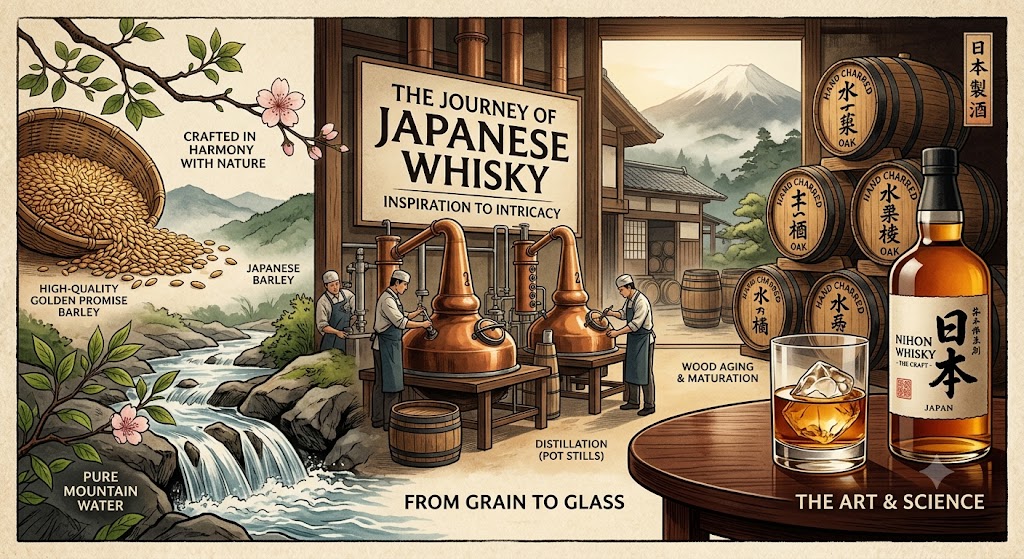
Speaking of Japanese whisky, did you know that Scotch whisky played a key role in serving as both an inspiration and a model for Japanese whisky? Who is the mastermind behind its creation? Let's start from the beginning. Since sake and soju have long been a part of the country's culture, distilled alcohol was not a new concept. However, the initial whiskies produced were of poor quality, resulting in a halt to production during World War 2. After these unsuccessful attempts, whiskey made a comeback with Shinjiro Torii and Masataka Taketsuru. Now let's unpack and explore how Japanese whisky is made and the steps in making Japanese whiskey, along with the history of it and how it is different from Scottish whisky.
History of Japanese whiskey:
Shinjiro Torii established Yamazaki in 1920 as Japan's first whisky distillery, later known as Suntory. To direct the distillery, he hired Masataka Taketsuru in 1923, a Japanese national who went to Scotland in 1918 to study organic chemistry but instead fell in love with Scotch production. 10 years later, Masataka decided to become independent and established his own distillery, known as Yoichi Distilleries, in 1934, which is Japan's second whisky distillery and produces whisky under the name Nikka whisky. The very first whisky by Nikka was launched in 1940.
From this point on, Japanese whiskies gained recognition and won various awards. In 2007, two Japanese whiskies took first place in the 'World Whiskies Award.' The 'World's Best Blended Malt' award went to Nikka Whisky Taketsuru Pure Malt, 21 years old, while 'World's Best Blended' went to Suntory Hibiki, 30 years old. Then in 2014, whiskey critic Jim Murray dubbed Yamazaki's 2013 Single Malt Sherry Cask "the best whisky in the world."
Now that we have a sneak peek into the history of Japanese whisky, the obvious question arises: What is the difference between Japanese and Scottish whiskies?
Differences between Japanese and Scottish Whiskies
How is Japanese whisky unique if it comes from Scottish whisky? Here are some key points where the basic principles of production differ significantly. Moreover, since April 2021, certain rules have been in place for whiskey to be labeled as Japanese whisky.
- The duration of whisky production is the first thing to consider. In Scotland, it occurs continuously throughout the year, while in Japan, it is seasonal. This means that the annual yield of Japanese distilleries is lower than that of Scotland.
- The second thing to consider is that natural springs provide the water for Japanese whisky. Water significantly influences the taste of these whiskies, and the condition of the water is much softer and milder than Scottish water. This means distilleries must control the quality of their water before making whiskey.
- The third thing is that Japan is subject to more monthly temperature changes than Scotland, which has a major influence on maturation and, therefore, flavor.
- Another important difference is that, unlike Scotland's focus on single malt, Japan produces in-house blends. This means crafting the complex blends solely from the whiskies within their own distillery to develop a unique style and produce a more complex flavor.
- Finally, Japanese distilleries produce whiskies with a higher ABV since they do not have to mature for as many years as Scotch, which results in a bolder, richer flavor than Scottish whisky.
How is Japanese whiskey made?
We have already established that the production process for Japanese whisky is similar to that of Scotch, so the basic ingredients are the same as barley, water, and yeast. You can also consult our previous blog on how Scotch is made to draw comparisons between the two. The steps in making Japanese whisky go as follows:
- Malting:
- Mashing:
- Fermentation:
- Distillation:
- Maturation:
- Bottling:
The production process begins with malting the barley, where barley grain is soaked in water to germinate. This ensures that enzymes required for the breakdown of starch into sugars during fermentation are activated. The germination can take up to 5–9 days. While germination occurs, we spread barley over malting floors and turn it over repeatedly to ensure even germination.
Once it reaches the desired germination point, it transfers to the kiln to end the germination process. However, there's a notable difference between Scotch and Japanese whisky in that the use of peat is rather uncommon, which adds a smoky flavor to the whisky.
The next step in making Japanese whisky is to grind the dried malt into coarse flour. It is mixed with water and poured into a mash tun to separate the sugar from the grain. The mash is leached three times with water at different temperatures to transform it into a sweet liquid known as wort.
The wort is cooled down to 20°C for the next step of fermentation, where yeast is added.
The wort is filled into large containers known as washbacks, where it remains for 2-4 days. This is where alcohol is made. The yeast is added to the mixture, where it feasts on the sugar present and converts it into alcohol and carbon dioxide. After 2-4 days, a beer wash is obtained with an alcohol content of 8–10%.
The distillation process is a two-step process that takes place in stills, which are like kettles. It is heated from below or from inside. The alcohol vapors rise first, leaving behind heavier water molecules toward the neck. The vapors are collected in a condenser, where they are cooled down and become liquid again.
The first distillation yields a liquid with an alcohol strength of 20–30%. The subsequent second distillation re-distills this liquid to increase its strength. Also, the second distillation divides the alcohol into three parts: the first, second, and middle cuts. The usable alcohol is the middle cut. After distillation, the final product is known as New Make and has an alcohol strength of roughly 70%.
Before filling the wooden cask, the alcohol strength is lowered to 65%, which is optimum for maturation. The new make is then poured into wooden casks for maturation for a minimum of 3 years, which gives it a golden brown color. Similar to Scotch whisky, Japanese whisky relies on the tradition of using oak casks. However, several distilleries use other options, like casks of umeshu, a Japanese plum liqueur, for maturation. This cask maturation gives the whisky a sweeter, velvetier personality than normal casks do. Besides, there is precious oak mizunara. Yet, it's a tough wood because of its high moisture content. Nevertheless, it adds unique and fascinating notes to the whisky, such as sandalwood, incense, and coconut.
The final step in making Japanese whisky is bottling, but before bottling, Japanese whisky is blended to the desired flavor, and sugar caramel food coloring is added to ensure that blends have a similar color. The whisky can also be bottled at cask strength, but usually the alcohol content is diluted to a minimum of 40% ABV.
Navigating through different types of Japanese whisky
There are two main ways to categorize Japanese whisky: grain bill or distillery release; other than that, there are other not-so-strict characterizations, such as production method, region, and distillery.
- Grain Bill:
- Distillery releases: depending upon distillery release, they concentrate on origin.
- Production methods: Although it's not a definitive classification, it depends on the type of distillation method used, such as pot still or column still. The pot still produces more full-bodied and robust flavors, whereas the column still produces lighter spirits and remains consistent.
- Region: The region itself plays an important role. For instance, Hokkaido's cooler climate can impact whisky's character.
- Distillery: Various major distilleries, such as Suntory, Nikka, and Yamazaki, have their own signature styles and expressions to explore.
- Taste with two house styles:
- The right glassware:
- Food pairing:
Single malt: Made exclusively from malted barley at one distillery, it is a classic with a pure malt flavor profile.
Grain whisky: This type of whisky is rarer; it has a significant addition of unmalted grains, usually rice, along with malted barley for lighter-bodied whiskies and a grain-neutral character.
Blended whisky: It is a blend of malt and grain whiskies from the same firm's distilleries and offers a wider variety of flavor profiles. Distillery releases today concentrate on origin: single malts come from a single distillery and project their individual personalities.
Single malts come from a single distillery and project their individual personalities.
Single grains are similar to single malts, but they are made entirely from grain whisky at a single distillery and are even less common than single malt.
World Blends is a completely new concept that combines Japanese whiskies with imported ones to create an international flavor profile.
| Type | Grain Bill | Distillery Release | Production Method | Region | Distillery | Description |
|---|---|---|---|---|---|---|
| Single Malt | 100% malted barley | From a single distillery | The pot is still preferred | Various | Suntory, Nikka, and Yamazaki | The product offers a pure malt flavor profile, typically associated with Scotch single malts |
| Grain Whisky | Blend of malted barley and unmalted grains | From a single distillery | Columns are still preferred | Various | Suntory, Nikka, and Yamazaki | It has a lighter body and a more neutral grain character, frequently combining grains like rice with malted barley |
| Blended Whisky | A blend of malts and grain whiskies | Blends from one company's distilleries | Varies | Various | Suntory, Nikka, and Yamazaki | It allows for a wide range of flavor profiles, from light and smooth to rich and complex, by blending different whisky types from the same company |
| Single Grain | Mostly unmalted grains (e.g., rice) | From a single distillery | Columns are still preferred | Various | Suntory, Nikka, and Yamazaki | Made entirely from grain whisky (not necessarily barley), it is less common than single malts but is gaining popularity |
| World Blends | Blends of Japanese and imported whiskies | From Japanese distilleries | Varies | Various | Suntory, Nikka, and Yamazaki | Japanese distilleries have recently introduced a unique international flavor profile by blending their whiskies with imported ones |
Japanese Whiskey Tasting Guide: Unveiling the Depths of Flavor
According to the Japanese whisky market, there are two renamed whisky houses: Suntory and Nikka. Suntory makes delicate, lighter whiskies that are ideal for beginners. For instance, try their Hibiki Japanese Harmony Whisky for a light, sweet, and crisp introduction. Whereas Nikka is inspired by Scottish traditions, its whiskies are bolder and more flavorful. If you like a punch, try their Nikka Japanese 21-Year Whisky, a blend with dried fruit and sweet spice notes.
Just like any whiskey tasting, it's important to select a type of glassware that aids in focusing scents. A lowball glass, also known as a rocks glass or tumbler, is best for serving Japanese whisky. Locals commonly serve the whisky neat, over ice, and with a splash of water, a combination known as mizuwari. Other than these more traditional serving suggestions, Japan is famous for some more intriguing local twists on how to enjoy their whisky, such as Oyuwari, which serves whisky with hot water, and haiboru, the Japanese term for a highball or whisky and soda.
Despite its exceptional pairing with Japanese food, Japanese whisky is not exclusive to Japanese cuisine. It is such a versatile spirit that it can make for exciting pairings across many cuisines, keeping in mind the flavor profiles of both food and Japanese whisky. For example, a peatier and smoky style of Japanese whisky works beautifully with stews or steaks, while a lighter and more fruity style will elevate delicate seafood dishes, harmonize with creamy cheeses like Camembert, and enhance the depth of dark chocolate.
The fever of savoring Japanese whiskey with delectables is high among folk, or even if you are looking to introduce a friend or loved one to this remarkable spirit, you can DIY or gift them a Japanese gift basket that you can explore from various online retailers or stores nearby.
To sum up, Japanese whisky provides unique experiences with its diverse styles, rich history, and meticulous production process. Dive deeper into the world of Japanese whisky and curate your own tasting experience; even explore gift baskets brimming with Japanese whisky and delectables.